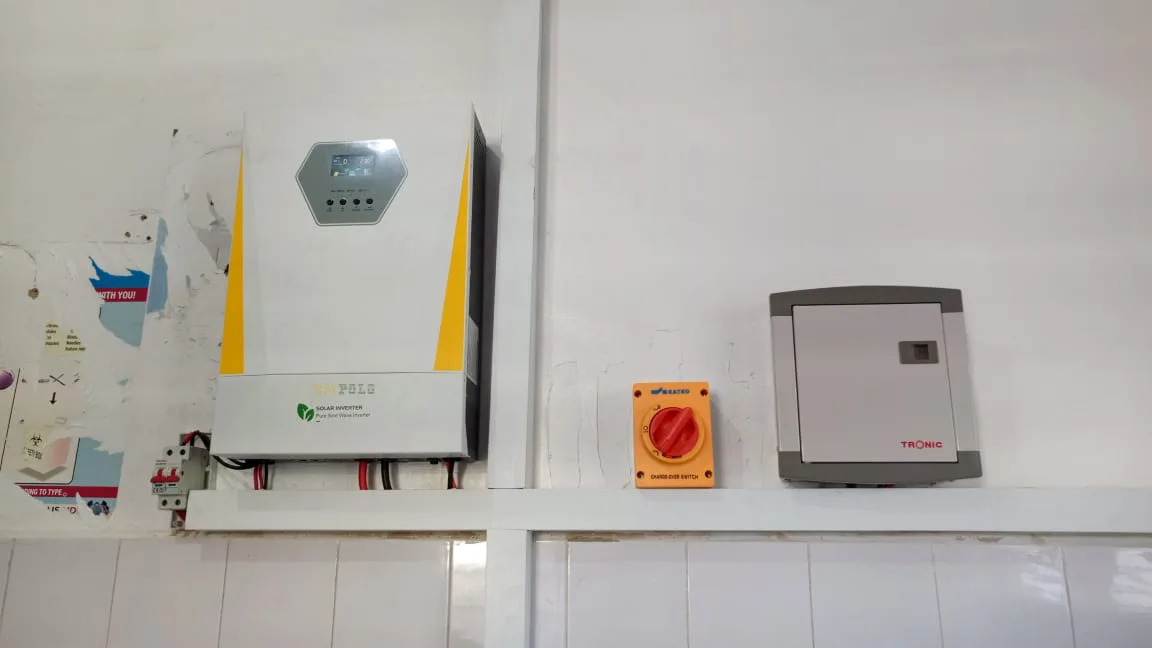
You've collected three solar quotes. Two have inverters of the same size, but one costs far more than the other. You ask why, and the answer is: "Ours is better quality. It lasts longer."
But what does quality actually mean?
Most people in the solar industry struggle to answer that question. So here is our answer, starting with the inverter — the brain of every solar system.
What quality means
A quality product isn't the most expensive one or the most famous brand. A quality product does four things:
- It delivers what it promises, in real conditions and not just on the spec sheet.
- It protects itself and your property from surges, heat, water and faults.
- It tells you what's happening, so problems are caught early.
- It's supported when something goes wrong, by someone local.
Everything else follows from these four.
It's supported when something goes wrong
We look at this before we look at any specification. A strong warranty means little if a claim means shipping the inverter overseas while you sit in the dark.
We choose brands with:
- A local distributor holding stock for replacements
- Spare parts available in Kenya
- Trained technicians who can come to site
- A track record: several years of being sold in Kenya and internationally, and a good reputation — how their products have performed in real installations, and whether the manufacturer honours warranty claims
Genuine products only. Counterfeit and grey-import solar products are common in Kenya. They look the same and cost less, but often come with no warranty anyone will honour. That's why every inverter, battery and panel we install is bought directly from manufacturers, authorised importers and main distributors in Kenya. You get the genuine product, with a warranty that's honoured locally.
It delivers what it promises
Starting power for heavy equipment. Some machines need far more power to start than to run. A pump that runs at 2 kW might need 5 kW for a moment when it switches on. A quality inverter handles that surge without tripping.
Room for the right number of panels. Quality inverters can accept more panel power than their rated output, so the system collects more energy from the sun.
Panels facing different directions. Imagine a roof with one side facing east and the other facing west. Each side gets sun at a different time of day. An inverter with more than one solar input (called an MPPT) can handle each side separately, so neither drags the other down.
Uneven loads in three-phase buildings. Buildings rarely use power evenly across their three phases. One phase might carry 5 kW while another carries 1 kW. Quality three-phase inverters handle this easily. Others struggle unless the loads are balanced.
Smart control of power sources. A quality inverter lets us decide which source comes first: solar, battery, KPLC or a generator. If running on the sun matters most to you, solar and battery come first. If you can never afford a power cut, the system can be set to keep power on at all costs. Some inverters can also start and stop a generator automatically.
Efficiency. Some energy is always lost when an inverter converts power. Better inverters lose less, so more of the sun's energy reaches you.
It protects itself and your property
Clean power for sensitive equipment. Computers, servers, medical equipment and motors need a smooth, steady power supply. Quality inverters produce cleaner power, which protects that equipment.
Fast switching. When power switches between sources, there's a tiny gap. Lights may flicker and a fridge won't notice. But computers, servers and medical equipment can shut down, and unsaved work is lost. Quality inverters switch fast enough that sensitive equipment keeps running.
Built-in protection. Quality inverters protect themselves against power surges, short circuits, high and low voltage, overheating, dust and water.
It tells you what's happening
A quality inverter shows how much energy your panels produced today, this month and this year, and how much you used. It also lets us see the system remotely, so many problems can be diagnosed without a site visit.
Not every feature belongs in every system
Here is the important part. A feature only matters if the system needs it.
A clinic running oxygen concentrators needs fast switching and clean power. A home with a borehole pump needs high starting power. A house with an east- and west-facing roof needs more than one solar input. A small shop may need none of these.
So the right inverter for one building is the wrong one for another. An expensive inverter isn't automatically better for you, and a cheaper one isn't automatically worse. An inverter can only be judged as part of the system it's going into.
Frequently asked questions
Why are some solar inverters so cheap?
Two inverters of the same size can differ in what's inside them and what's behind them. Cheaper models often have less protection against surges and heat, handle less starting power, give little or no monitoring information, or have no local distributor to honour the warranty. Some are grey imports that were never meant for the Kenyan market.
A lower price isn't automatically a bad sign. A simpler inverter can be the right choice for a simple system. The real question is whether it does what your system needs, and whether someone in Kenya will stand behind it if it fails.
You don't need to remember any of this
That's our job.
When we recommend an inverter, it's because we've considered your loads, your building, your power supply and what you want solar to do — and chosen the inverter that fits.
Good products. Good design. Good installation. That's Solar Done Right.
Tell us what you want solar to do
We'll design the system around it — inverter, batteries, panels and all.
💬 WhatsApp Us →Next: what quality means in batteries and solar panels.